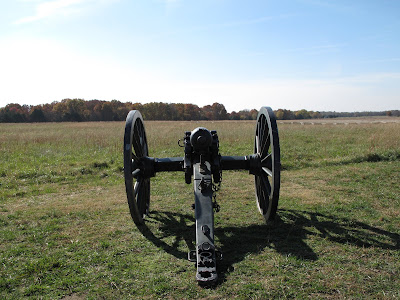
Northeastern Oklahoma is experiencing a heat wave, and I decided to look up some quotes from Civil War soldiers in the trans-Mississippi to see what they had to say about summer weather. My unscientific and admittedly rather brief survey of primary accounts led to a surprising conclusion; Union soldiers seemed more apt to comment in detail about the weather than their Confederate opponents. All of the following quotations are from the Union perspective, but hopefully I’ll locate some lively quotations about summertime weather from the Confederate point of view. Another conclusion… summer weather was just as dreadful in the 1860s as it is now, however, we have a great advantage…air conditioning.
Franc B. Wilkie, Springfield, Missouri:
From a dispatch dated August 2, 1861:
“The weather was hot—slightly. I rather enjoy respectable hot weather, such for instance as will cook an egg hard in two minutes, or roast a joint equal to a Dutch oven; but the weather of that day was a little too much for even my ardent constitution. There were men with us who had toasted their chins beneath the vertical rays of a tropical sun; there were others who went through the fiery rays of Mexico’s sun during the war, but all confessed that they never had known anything comparable to that. I won’t undertake to say how many degrees hot it was, as we had no thermometer, but will venture the guess that it was anywhere between 1,100 and 2,000 ‘in the shade.’ Men dropped in the ranks as if smitten by lightning; under every tree and beneath every bush they staggered and fell in groups of twos and dozens.”
Banasik, Michael E., ed., Missouri In 1861: The Civil War Letters of Franc B. Wilkie, Newspaper Correspondent, Unwritten Chapters of the Civil War West of the River, Volume IV, (Iowa City: Camp Pope Bookshop, 2001), 131-132.
William P. Black, Springfield, Missouri:
“Springfield, Mo. July 10th 1862….What exceedingly hot weather we have been having in these weeks past. No rain this month till to-night, when the windows of heaven seemed open to us to pour out a bounteous blessing. Already we feel the cooled & refreshed vigor of the air, & we all rejoice. The ground had become parched, vegetation of all kinds was withering up, gardens were blighting, & roads were a bed of dust. But now is a day of better things. As is nearly always the case at the breaking up of such a hot spell of weather, however, we had quite a gust of wind & a thunder-shower—The clapps were at times very sharp & close but now they have retired to the distance & seem as if some one had retired to heaven’s growlery & were doing his best to maintain the expectation of the place. And still the rain comes down steadily & joyously, giving life & health.”
Banasik, Michael E., ed., Duty, Honor and Country: The Civil War Experiences of Captain William P. Black, Thirty-Seventh Illinois Infantry, Unwritten Chapters of the Civil War West of the River, Volume VI, (Iowa City: Camp Pope Bookshop, 2006), 111-112.
August Scherneckau, Fort Davidson, Missouri:
“Tuesday, June 16 [1863]—Very warm. We had drill as usual in the morning and afternoon, today under our new commander, who seems to be more concerned about us than any one of our own officers. Even though the exercise is not very strenuous, it is sufficient to bring out the sweat. Our campground is without shade, and the sun burns on our tents without mercy; therefore, it is unbearably hot inside. To remedy this misfortune, we have built various huts of leafy branches in which we pass the hot daytime hours. They are somewhat more airy and shady.”
Potter, James E. and Edith Robbins, eds., Marching With The First Nebraska: A Civil War Diary, (Norman: University of Oklahoma Press, 2007), 173.
Charles O. Musser, Helena, Arkansas:
“Helena, Arkansas July the 9th, 63….The weather is almost too hot for a white man to live here. i never felt Such hot Sun before. we lay in our tents almost panting for breath. it [is] awful Sultry. I will never complain of the hot sun in Iowa again if i get there.”
Popchock, Barry, ed., Soldier Boy: The Civil War Letters Of Charles O. Musser, 29th Iowa, (Iowa City: University of Iowa Press, 1995), 67-68.
“An officer with the Native Battalion, stationed at Fort Yuma [California] in August 1865, wrote home: ‘For heaven’s sake, never come out this way if you can help it. You will surely melt. The thermometer is 112 in the shade every day, with no wind. Scorpions thick as molasses and flies still more. When we want to drink cool water we have to boil it and drink it immediately or else it gets hotter.’”
Masich, Andrew E., The Civil War in Arizona: The Story Of The California Volunteers, 1861-1865, (Norman: University of Oklahoma Press, 2006), 105-106.